Santa Eulalia, Ibiza: what to see and why families love it
Santa Eulària des Riu (Santa Eulalia) is the calmest, most family-friendly town on Ibiza's coast: a seafront promenade with a town beach, the fortified church on Puig de Missa, the river the town is named after, sandy coves minutes away and the island's two biggest hippy markets.
If San Antonio is the party and the capital is the hustle, Santa Eulalia is the evening stroll. It's one of the largest towns on the island, with around 21,600 people in the town itself and 42,500 across the municipality (2025 register), and it has a reputation as the place where families stay, along with couples who aren't after clubs and many of the foreigners who live in Ibiza all year round.
It isn't a postcard village: the centre is modern and tidy, with straight streets laid out in the early 19th century. But it has what plenty of people want on holiday: a beach on foot, restaurants for every budget, quiet nights and a hill topped by one of the loveliest churches in the Balearics. This guide covers what to see, what to do nearby and when to go.
Santa Eulalia Ibiza: the town and the seafront promenade
The town is built around two long parallel streets running down to the sea:
- Passeig de s'Alamera: a tree-lined boulevard with benches, with the town hall at the top on Plaça d'Espanya. From May to October it has craft stalls several days a week.
- Carrer de Sant Jaume: the restaurant and shopping street, with terraces almost door to door.
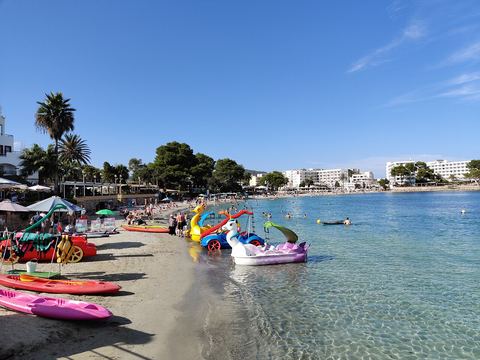
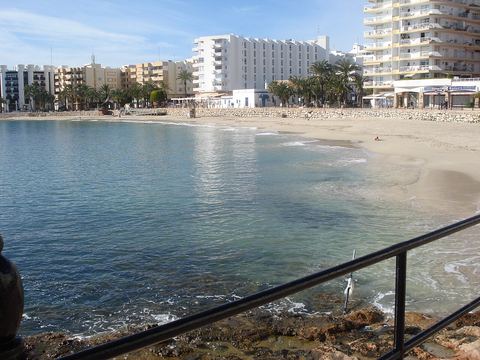
At the bottom is the seafront promenade, running alongside Santa Eulària beach, a sandy town beach with calm water, as far as the marina at one end and the river mouth at the other. In the early evening it's where everyone meets: families with buggies, runners and busy terraces. The sun doesn't set over the sea here (the coast faces east), but the late light over the bay has its own charm.
For lunch and dinner, the town has one of the most varied choices on the island, from the menú del día to chef-led cooking. The guide's list is in restaurants in Santa Eulària.
Puig de Missa and the ethnographic museum
Above the town rises Puig de Missa, the hill where Santa Eulalia began. At the top stands its church, consecrated in 1568 on the site of an earlier one. It's a fortress church, designed to shelter residents from pirate raids: it has a semicircular tower attached that kept its artillery until the mid-19th century, and a porch of white arches, the largest on the island, which gives welcome shade. Inside, the highlight is a Baroque altarpiece from the 1670s that came from a church in Segovia in the 20th century. Behind it is the small cemetery, with views over the town and the sea.
Next to the church, in the Can Ros farmhouse, the Museu Etnogràfic d'Eivissa shows how people lived in the Ibizan countryside: farm tools, kitchen utensils, traditional dress and the layout of a farmhouse. On the same hill there's a room devoted to the painter Laureà Barrau, who lived in Santa Eulària from 1932 until his death. Opening hours for both change with the season: check with the town hall (971 33 28 00) before you walk up.
It's about ten minutes on foot from the centre, up steep streets. In summer, go first thing or late in the afternoon; at midday there's no shade.
The Santa Eulalia river: the only one in the Balearics (and how true that is)
The town's full name means "of the river", and the town hall presents it as the only river in the Balearic Islands. Is it true? Partly. It's a watercourse about 17 kilometres long that runs down from the inland hills to the sea right beside the town. Until the mid-20th century it flowed all year round, which was exceptional on islands where almost everything is a torrent that only runs after rain. Its water irrigated the market gardens and turned the flour mills. Today, with the aquifer heavily exploited, the lower stretch flows only intermittently, and the river mouth forms a wetland with reeds and birds.
The best way to get to know it is the River Route (R13), a waymarked loop of about 3 kilometres with 19 points of interest. It's very easy, suitable for all ages and takes an hour and a half. It starts at the town hall, drops down to the promenade, follows the riverbed and climbs to Puig de Missa. Along the way you'll see:
- The Pont Vell, an 18th-century bridge with two legends, one about the devil and another about a fameliar, the goblin of Ibizan folk tales.
- The old watermills on the slopes of Puig de Missa.
- Can Planetes, the highest mill, probably of Moorish origin, which worked until the 18th century and is now the river's interpretation centre.
If you like walking, there are more routes in Ibiza hiking trails.
Es Cana, Cala Llonga, Sant Carles and the east coast
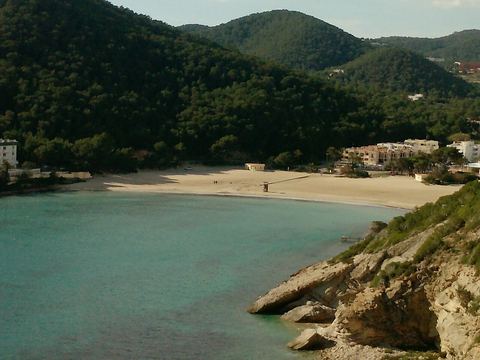
Santa Eulària is the gateway to the east coast, the one with sandy coves and calm water. These are the main ones, from south to north:
| Place | Drive | What it's like |
|---|---|---|
| Cala Llonga | 10 min | Long bay between pines, fine sand, very family-friendly |
| Platja des Riu | On foot | At the river mouth |
| S'Argamassa | 5 min | Small, beside the remains of a Roman aqueduct |
| Cala Pada | 5 min | Sand and pines; in season, boats to town and Es Cana |
| Es Canar | 10 min | Family resort (Es Cana in English); home of Punta Arabí |
| Cala Nova | 12 min | More exposed; waves come in with an easterly wind |
| Cala Llenya | 15 min | Quiet, golden sand |
| Cala Mastella | 20 min | Small, tucked among pines |
| Es Figueral | 20 min | Reddish sand and clear water, to the north |
Inland, Sant Carles de Peralta is a must: its white late 18th-century church, the Ca n'Anneta bar with its wooden post boxes and hierbas, and the memory of the hippie years. Santa Gertrudis, also in the municipality, is the liveliest inland village. Both are in Ibiza villages to visit. To eat in the area, see restaurants in Es Canar, Cala Llonga and Sant Carles.
Hippy markets: Punta Arabí and Las Dalias
Ibiza's two most famous markets are in this municipality:
- Punta Arabí, in Es Cana: Wednesdays from April to October, 10:00 to 18:00. It's the biggest, with hundreds of stalls selling clothes, crafts, jewellery and food.
- Las Dalias, near Sant Carles: Saturdays all year, 10:00 to 19:00 in 2026 (shorter in winter), plus a night market on Mondays and Tuesdays in summer. It started as a bar in 1954 and is now a venue with terraces and music rooms.
The Passeig de s'Alamera also has craft stalls in season. Days, times and how to get there in Ibiza hippy markets.
The May fiestas and the rest of the calendar
The patron saint, Santa Eulàlia, is celebrated on 12 February, but the municipality's big fiesta is the First Sunday of May, at the heart of a whole month of Festes de Maig. That Sunday (3 May in 2026) brings bell-ringing, a show of Ibizan hounds, mass with ball pagès folk dancing and, at midday, a parade of carts, horses and vintage cars through the centre. The evening before, the May fair opens with a flower show. It's the best chance on the island to see restored farm carts and traditional dress.
There are more fiestas around the municipality: Es Cana in July, Cala Llonga in August, Jesús on 8 September, Sant Carles on 4 November and Santa Gertrudis on 16 November. Full calendar in Ibiza village festivals.
Why it's the most family-friendly area in Ibiza
- Gently shelving beaches with calm water: the town beach, Cala Llonga, Es Cana or Cala Pada.
- A flat, pedestrian promenade, ideal with a buggy, and a playground by the river mouth.
- Quiet nights: there are no big clubs in town.
- Services all year: health centre, pharmacies, supermarkets and restaurants that don't close in winter.
- Short distances: by car, the airport is about 30 minutes away and the capital 20.
More ideas for travelling with kids in Ibiza with kids, and how the areas compare for a base in where to stay in Ibiza.
What about nightlife?
There is some, but it's bar-based: terraces with music at the marina and on Carrer de Sant Jaume, the odd venue with a DJ, and live music at Las Dalias. Es Cana is a bit busier in summer. For the big clubs you'll need to head to Ibiza Town or Playa d'en Bossa; in summer, the D4 club bus links Ibiza harbour with Santa Eulària and Es Cana.
Getting there and getting around
| From | Option | 2026 details |
|---|---|---|
| Airport | AERO4 bus | Hourly in season (every 2 hours in winter); about 37 min; €4 by card |
| Airport | Taxi | Around €33-38 by day |
| Ibiza Town | T3 bus | Every 20 min on weekdays in season; 30-45 min |
| San Antonio | T5 bus through the interior | Doesn't go via Ibiza Town |
| Ibiza Town (at night, summer) | D4 club bus | Every night from June to September |
| Ibiza harbour | Water taxi (in season) | Several sailings a day between the harbour, Santa Eulària, Cala Pada and Es Cana; times from the operator |
Taxis and transfers are covered in Ibiza airport transfers. In summer, excursion boats to Formentera also leave from the east coast, slower than the regular ferry but without going through Ibiza Town: we compare them in the Ibiza to Formentera ferry. By car, the town has public car parks around the centre; on August evenings it's hard to find a space near the promenade.
Santa Eulalia in winter
Along with Ibiza Town, it's the place on the island that copes best with winter. Many residents live here year round, so the restaurants in the centre, the supermarkets and shops stay open. The promenade in the midday sun is a plan in itself, and the River Route and Puig de Missa are more enjoyable without the heat. On Saturdays, Las Dalias keeps its market going on winter hours.
What closes: nearly all the hotels in Es Cana and Cala Llonga, Punta Arabí (November to March) and most beach bars. More low-season ideas in Ibiza in winter.
Common mistakes
- Expecting a sunset over the sea. The coast faces east: for that you need the west coast.
- Climbing Puig de Missa at two in the afternoon in July. It's uphill with no shade.
- Going to Punta Arabí on a Saturday. It's on Wednesdays; Saturday is Las Dalias.
- Looking for clubs. Nights here are spent on terraces; the big parties are elsewhere on the island.
- Assuming the river always has water. It flowed all year until the mid-20th century; today it depends on the rain.
Sources and official information
- Ajuntament de Santa Eulària des Riu · Churches in the municipality
- Ajuntament de Santa Eulària des Riu · River Route (R13)
- Ajuntament de Santa Eulària des Riu · Museums and art
- Ajuntament de Santa Eulària des Riu · Santa Eulària parish
- Ajuntament de Santa Eulària des Riu · Markets
- Transport Públic d'Eivissa (Alsa) · Timetables
- Viquipèdia · Santa Eulària des Riu (INE 2025 register and history)
Frequently asked questions
What is there to see in Santa Eulalia, Ibiza?
The essentials are Puig de Missa, with its 1568 fortress church and the Can Ros ethnographic museum; the River Route, with the Pont Vell and the old mills; the Passeig de s'Alamera and the seafront promenade. Around it, the east-coast coves, Sant Carles and the Punta Arabí and Las Dalias hippy markets.
Is Santa Eulalia good for families?
Yes, probably the best area in Ibiza for them. It has a sandy town beach with calm water, a flat promenade, a playground, nights without club noise and family coves such as Cala Llonga, Cala Pada and Es Cana a few minutes away. It also keeps services and restaurants open all year round.
Is there nightlife in Santa Eulalia?
There's a bar and terrace scene, mainly at the marina and on Carrer de Sant Jaume, and live music at Las Dalias, but no big clubs. For those, head to Ibiza Town or Playa d'en Bossa; in summer, the D4 club bus links Ibiza harbour with Santa Eulària and Es Cana.
How do I get from Ibiza airport to Santa Eulalia?
By bus, on the AERO4, which runs hourly in season, takes about 37 minutes and costs €4 paying by card; in winter it runs every two hours. A taxi costs around €33-38 by day. By car it's 25 to 35 minutes depending on traffic.
When is the Santa Eulalia fiesta?
The patron saint is celebrated on 12 February, but the big fiesta is the First Sunday of May, during the Festes de Maig, with mass and ball pagès, an Ibizan hound show and a parade of vintage carts. In 2026 it fell on 3 May. There are also fiestas in Es Cana, Jesús, Sant Carles and Santa Gertrudis.
Does Santa Eulalia really have the only river in the Balearics?
That's how the town hall presents it, and there's something to it: until the mid-20th century it flowed all year round, which was exceptional on islands of dry torrents. It's about 17 kilometres long and used to turn mills and water the market gardens. Today its flow is irregular and depends on rain, but the River Route lets you follow it.