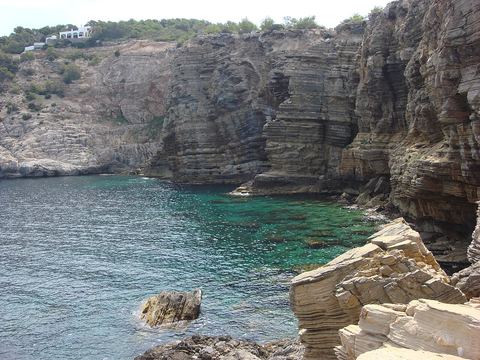
Ses Salines Natural Park: salt flats, flamingos and beaches
Ses Salines is southern Ibiza's natural park: working salt pans, over 200 bird species (with flamingos from August to spring), juniper forests, posidonia seagrass meadows and the ses Salines and es Cavallet beaches. Entry is free. The P3 bus runs in summer and the A7 all year round.
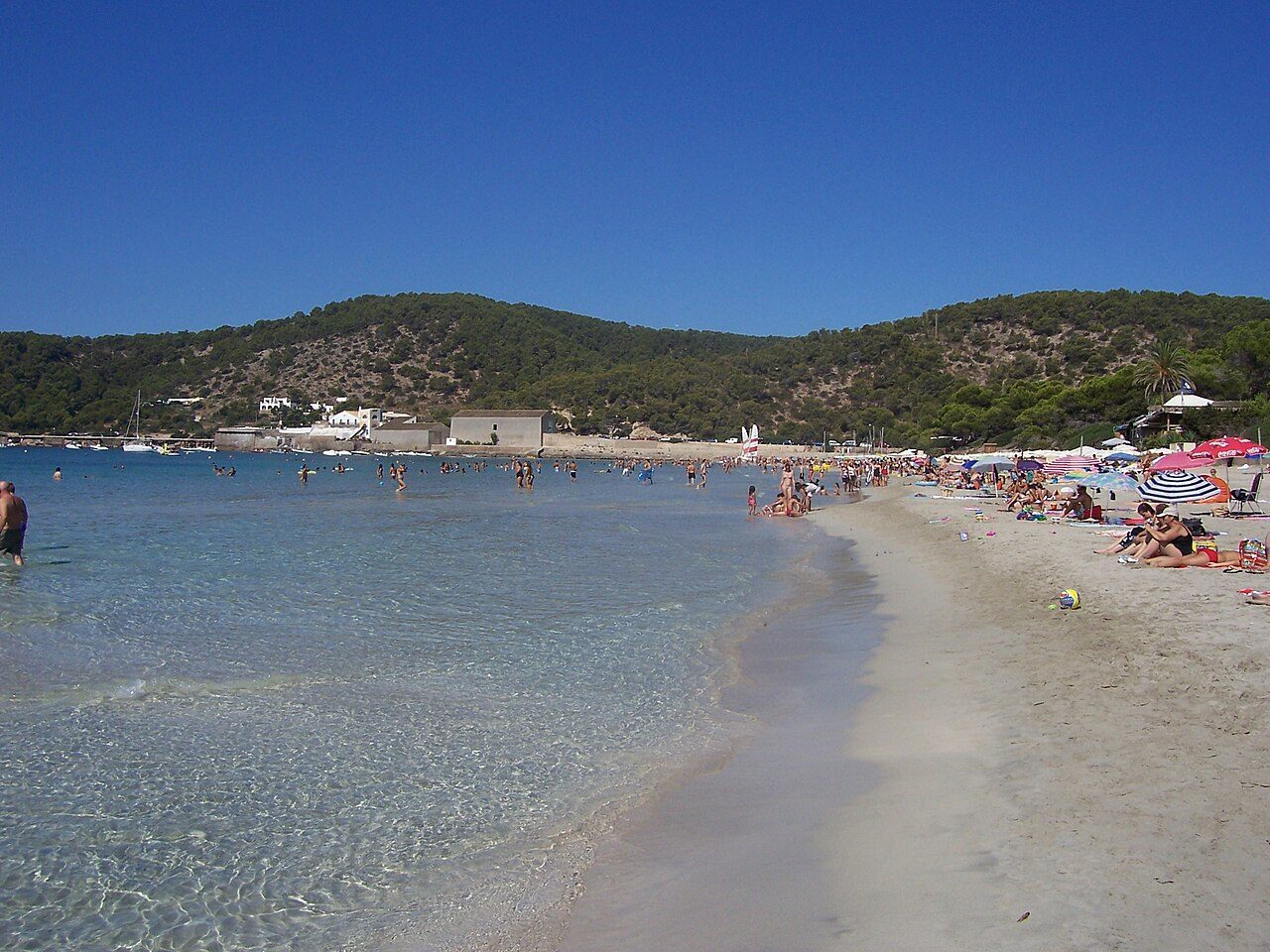
Photo: Zavijavah, CC BY-SA 3.0, Wikimedia Commons
South of the airport, Ibiza's landscape changes abruptly. The pine-covered hills disappear and in their place come still, flat water, white mountains of salt, juniper trees twisted by the wind and two of the island's most famous beaches. This is the Ses Salines Natural Park, an area shared by Ibiza and Formentera that protects at once an industry almost three thousand years old, one of the best birdwatching sites in the Balearics and the seabed that earned the island its World Heritage status.
You can visit in many ways: as a beach day, as a walk or bike ride, as a trip to see flamingos or as a history lesson. Here's everything worth knowing to choose yours.
What Ses Salines Natural Park in Ibiza protects
The Balearic Parliament declared it a natural park under Law 17/2001 of 19 December, although the area already had other kinds of protection before (nature reserve, special protection area for birds and a Ramsar wetland). It covers the south of Ibiza, in the municipality of Sant Josep de sa Talaia, the north of Formentera and the stretch of sea between them, es Freus, with its islets.
According to the Enciclopèdia d'Eivissa i Formentera, it covers around 1,787 hectares of land and 13,612 of sea: above all, it's a marine park. What it protects:
- The salt pans: around 400 hectares of ponds in Ibiza, the largest wetland in the Pitiusas.
- The birds: Sant Josep town hall reports more than 200 species recorded, including residents, winter visitors and migrants.
- The posidonia meadows: the seagrass that filters the water and gives the beaches their turquoise colour. Together with the culture of Dalt Vila, it's the reason UNESCO declared "Ibiza, Biodiversity and Culture" a World Heritage site in 1999. Around 220 species live in its meadows.
- The juniper woods and dunes: forests of Mediterranean juniper on the sand, very fragile.
- The heritage: defence towers, the salt workers' village of sa Canal, wells and loading jetties.
| Fact | Figure |
|---|---|
| Declared | Law 17/2001 of 19 December |
| Land area | About 1,787 ha |
| Marine area | About 13,612 ha |
| Salt ponds in Ibiza | About 400 ha |
| Birds recorded | More than 200 species |
| UNESCO | World Heritage since 1999 |
The salt pans and their salt: then and now
Ibiza's salt pans have probably been worked since Phoenician and Punic times, although there are no clear archaeological remains from that first period. What is documented is that after the Catalan conquest, in 1267, the rights passed to the islanders themselves, and the Universitat (the island's government) managed them until the 18th century. Salt was Ibiza's great source of wealth: it paid for walls, wages and debts.
In the 19th century the state put them up for auction (1871) and they ended up with a private company which, in 1898, became Salinera Española, the firm that still works them. At harvest time up to a thousand people from Ibiza and Formentera worked there at once, and in 1920, an exceptional year, 111,000 tonnes were produced. At the start of this century the harvest was around 40,000-50,000 tonnes a year, mostly for export.
How it works: seawater flows through channels into shallow ponds, the sun and wind evaporate it through spring and summer, and at the end of summer the crystallised salt is gathered and piled into the famous white mountains. The water in the ponds turns pink because of microorganisms and a tiny crustacean, the same one the flamingos feed on.
Since the early 20th century the salt has been loaded onto ships at sa Canal, the old salt workers' village with its jetty, which you'll see as you arrive at ses Salines beach. If you want a souvenir, ses Salines salt is sold in shops and markets around the island, as coarse salt, flakes or mixed with herbs. How it's used in local cooking is in traditional Ibiza food, and more history in Ibiza history and heritage.
Flamingos and other birds: when to see them
The flamingo is the park's emblem. According to Sant Josep town hall, they arrive between August and October; hundreds spend the winter on the ponds and many more stop to rest before heading on to Africa. So the best time to see them runs from late summer to spring, with the biggest numbers in autumn and winter.
Other birds you can see at ses Salines:
- Black-winged stilt (camallonga in Ibizan), with its extremely long red legs, and Kentish plover, which breeds on the edge of the ponds.
- Herons and egrets, especially during migration.
- Storks, passing through in autumn.
- Eleonora's falcon and osprey on the cliffs of cap des Falcó, to the west.
- Gulls and seabirds along the coast and in es Freus.
Where to watch: next to the church of Sant Francesc de s'Estany there's a platform for watching and photographing birds, and another raised one about 300 metres away. Early morning and late afternoon are best. Bring binoculars, stay on the paths and keep away from nests in spring: the plover lays its eggs on the ground and every footstep counts.
The park's beaches
The park includes some of Ibiza's best-known beaches, with crystal-clear water thanks to the posidonia:
- Ses Salines: long, with fine sand, beach bars and a lively atmosphere in summer. The north end is more family-friendly; towards the south, quieter.
- Es Cavallet: on the other side of the point, wilder, with a long naturist tradition along much of its sand.
- Punta de ses Portes: the southern tip, with the defence tower, rocks and small coves with very clear water.
- The far end of Playa d'en Bossa: the southern end of the beach, by the Torre de sa Sal Rossa, borders the park and is the start of one of its routes.
In summer, arrive early or late. At midday in July and August the beaches fill up, and so does the car park. The Ibiza beaches guide has a page for each one with facilities and access.
Walking and cycling routes in ses Salines
Ses Salines is flat, so it's ideal for walking or cycling without much effort. Sant Josep town hall publishes two routes with tracks:
The ses Portes route
It links sa Canal with ses Salines beach, the juniper forest on the dunes and Torre de ses Portes, a late 16th-century defence tower that protected the tuna fishery and watched over the crossing to Formentera. From the tower you carry on north via es Cavallet and can finish at the sa Revista chapel. There's a shortcut along the edge of the ponds. It's one way and easy, but with no shade.
The sa Sal Rossa route
It starts at the church of Sant Francesc de s'Estany, with its birdwatching platforms and the sculpture dedicated to the salt workers, and follows the canal towards Playa d'en Bossa. Along the way, a plaque marks the cave where the poet Rafael Alberti and María Teresa León hid in 1936. It ends at the Torre de sa Sal Rossa, built by the Universitat in the second half of the 16th century as a refuge for the salt workers against pirates, on the headland between the beach and sa Xanga cove. Return the same way.
By bike, the tracks between the ponds and the ses Salines road are flat and easy, although in summer there's heavy traffic on the access road. For more routes across the island, see Ibiza hiking trails.
Getting there, parking and park rules
By bus
On the 2026 bus network, two routes reach ses Salines:
- P3 Eivissa-Platja d'en Bossa-ses Salines: the summer beach route, roughly every hour and a half from June to September, about 45 minutes from the Ibiza Town bus station.
- A7 Eivissa-Sant Jordi-ses Salines: an accessibility route running via Sant Jordi.
Timetables change through the year and some months have few departures: check the ALSA Ibiza website or app before you go. Everything about the network is in Ibiza bus routes.
By car
From Ibiza Town it's about 20 minutes via Sant Jordi and the ses Salines road. Entry to the park is free, but parking by ses Salines beach isn't: in season the car parks charge (in 2025 the local press reported about €7 per car and €3 per motorbike from mid-April) and they fill up by midday. Limiting car access to the park has also been debated for years, so conditions may change: check Balears Natura, the regional government's protected areas portal, before you go. If you don't fancy hunting for a space, share a car through the app or take the bus.
Rules to keep it beautiful
- Don't walk on the dunes or the vegetation: use the boardwalks and marked paths.
- Don't go into the ponds: they're a private industrial operation and a nesting area.
- Don't take sand, salt from the ponds, plants or shells.
- No fires, barbecues or candles, and camping is banned.
- Anchoring: if you're on a boat, you can't anchor on posidonia, which is protected in the Balearics by Decree 25/2018. Use the buoys or drop anchor on sand.
- Drones: the park is right next to the airport. Check ENAIRE's restrictions before even thinking about flying.
- Dogs: always on a lead in the park, and check each beach's rules in season.
- Rubbish: there aren't bins everywhere; take yours with you.
When to go
- Spring (March-May): flowers, migrating birds and perfect walking temperatures.
- Summer: the beach, early. The heat, and the mosquitoes around the ponds at dusk, are real.
- Autumn and winter: the best time for flamingos and for walking without the crowds. The low light on the salt is beautiful.
Ses Salines on Formentera
The other half of the park is in the north of Formentera. That's where you'll find the Estany Pudent and Estany des Peix lagoons, the old salt pans (no longer in production) and the beaches of ses Illetes and Llevant, with the islet of s'Espalmador opposite. It's the part that gets the most visitors in summer, which is why vehicle access to ses Illetes and Llevant is regulated in season: there's a limit on spaces and non-residents' cars and motorbikes pay a fee, while entry on foot or by bike is free. Check the year's dates and prices with the Consell de Formentera.
To get there, ferries from Ibiza harbour take about 30 minutes. How to organise it in Formentera day trip from Ibiza. From the sea, in es Freus, you'll see the islets of s'Espalmador, s'Espardell and els Penjats, also part of the park.
Sources and official information
- Sant Josep tourism · Visiting the ses Salines Natural Park
- Sant Josep tourism · Ses Portes route
- Sant Josep tourism · Sa Sal Rossa route
- Govern de les Illes Balears · Balears Natura (protected natural areas)
- UNESCO · Ibiza, Biodiversity and Culture (417rev)
- Enciclopèdia d'Eivissa i Formentera · Ses Salines
- Transport Públic d'Eivissa (Alsa) · P3 and A7 routes
- Periódico de Ibiza · Parking charges at ses Salines (16-4-2025)
Frequently asked questions
What can you see at ses Salines in Ibiza?
Working salt ponds with their white mountains, flamingos and other birds, juniper forests on the dunes, Torre de ses Portes, the salt workers' village of sa Canal and two famous beaches, ses Salines and es Cavallet. There are flat walking and cycling routes, and birdwatching platforms at Sant Francesc.
Are there flamingos at ses Salines?
Yes. According to Sant Josep town hall they arrive between August and October, and hundreds spend the winter on the ponds; others just stop to rest on their way to Africa. You'll see them best from September to spring, early in the morning or at dusk, from the platforms at Sant Francesc de s'Estany.
When is the best time to visit ses Salines?
It depends what you're after. For the beach, go in summer first thing or late in the afternoon. For flamingos and walking, September to April, with fewer people and better light. Spring is ideal for walking and seeing migrating birds. Avoid midday in July and August.
Do you have to pay to enter Ses Salines Natural Park?
No, entry to Ses Salines Natural Park in Ibiza is free. What you pay for in season is parking by the beach (about €7 per car in 2025). In Formentera, non-residents' vehicles pay to enter ses Illetes in summer; on foot or by bike it's free.
Is there a bus to ses Salines?
Yes. On the 2026 network, the P3 beach bus runs from Ibiza Town via Playa d'en Bossa roughly every hour and a half from June to September, and the A7 route runs via Sant Jordi. Timetables change by season: check the ALSA Ibiza website or app before you set off.
Can you take salt from the salt pans?
No. The ponds are a private industrial operation and a bird breeding area, so you can't go in or take salt. If you want ses Salines salt, it's sold packaged in shops, supermarkets and markets around the island, as coarse salt, flakes or mixed with herbs.