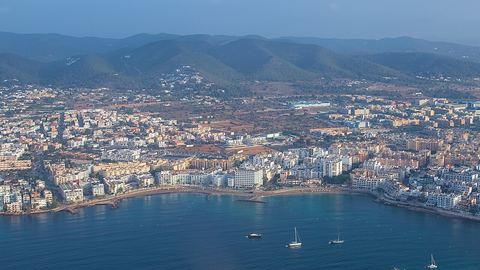
Living in Ibiza year round: the good, the hard and the cost
Living in Ibiza year round is possible, but you need to arrive with a plan. The hardest part is housing: there are few long-term rentals and prices are among the highest in Spain. Work depends on summer and winter is very quiet. In return you get nature, safety, public healthcare and people from all over the world.
Plenty of people fall for Ibiza during a week in August and start browsing flats as soon as they get home. That Ibiza, with packed terraces and boats in every cove, is only one part of the year. People who live here also know the February version: empty roads, shutters down in the beach resorts, almond trees in blossom and afternoons when you bump into the same faces at the market. This guide is for deciding with your feet on the ground: what's genuinely good, what it costs (in euros and in effort) and what to sort out before you pack.
Living in Ibiza: the short answer
If you've got a job lined up and somewhere to sleep before you arrive, living in Ibiza is a great experience. If you come looking for both at once in the middle of the season, you'll have a rough time. Here it is in two columns:
| The pluses | The minuses |
|---|---|
| Short distances: end to end in under an hour by car | Scarce, very expensive housing, especially April to September |
| Nature ten minutes from home: coves, trails, pine forest | An economy tied closely to tourism and the season |
| A strong sense of safety and a slow pace outside summer | Winters with lots of businesses closed and fewer flights |
| A public hospital, health centres and schools in every municipality | Groceries, services and repairs cost more than on the mainland |
| An international community and easy outdoor plans | Saturated Augusts: traffic, noise and queues for everything |
The island had 163,755 registered residents on 1 January 2025, according to Spain's statistics office (INE), spread across five municipalities. In summer the real population on the island is far higher, as tourists and seasonal workers join the residents.
| Municipality | Population (INE, 1-1-2025) | Who it suits |
|---|---|---|
| Eivissa (Ibiza Town, Vila) | 55,337 | People who want services, year-round life and no need for a car |
| Santa Eulària des Riu | 42,479 | Families and anyone after a large, quiet town |
| Sant Josep de sa Talaia | 29,761 | People working at the airport or in the south who don't mind driving |
| Sant Antoni de Portmany | 29,132 | Young people and hospitality workers; very different in winter |
| Sant Joan de Labritja | 7,046 | Rural life and calm; a car is almost essential |
The housing problem (the data)
There's no gentle way to say it: housing is the filter. People on good salaries leave Ibiza because they can't find anywhere to live, and seasonal workers pay for a shared room what a whole flat costs in other cities.
Some figures to give you an idea:
- Buying: according to Fotocasa's October 2026 index, the asking price per square metre is around €7,843 in Santa Eulària des Riu, €7,470 in Sant Antoni, €7,014 in Ibiza Town, €6,785 in Sant Josep and €6,427 in Sant Joan. The average across the Balearics is €4,476.
- Formentera, the neighbouring island, appeared in the local press in October 2026 as the municipality with the most expensive housing in Spain, at €10,332 per square metre.
- Affordability: the Balearic Economic and Social Council's 2025 report estimates that a family in Ibiza and Formentera spending 30% of its income would need about 61 years to pay for a home.
- Renting: according to Fotocasa's annual report, in December 2025 rent in Ibiza Town cost €23.34 per square metre per month, 20% more than a year earlier; the Balearic average was €18.69. The regional government's public Lloguer Segur scheme allows landlords to be paid up to €2,100 a month in Ibiza and Formentera, compared with €1,500 in Mallorca and Menorca. The fact that the authorities have to set that ceiling says a lot about the market.
- Few long-term lets: in mid-October 2026, one of the big property portals listed around a hundred rental ads for the whole municipality of Ibiza and about 36 in Sant Antoni, and some of those were short-term lets.
In practice, newcomers usually start with a room in a shared flat and, with time and contacts, move on to a flat of their own. The best months to look are October and November, when seasonal workers leave, and the worst are April to June. All the detail (prices, contracts, deposits, scams and grants) is in our guide to renting a room or flat in Ibiza.
Cost of living in Ibiza per month (rough guide)
Rent eats up most of the budget. The rest is similar to an expensive mainland Spanish city, with a few island extras: anything that arrives by ship costs more, and services (plumbers, mechanics, removals) are in heavy demand in season. In September 2026 inflation in Spain reached 4.9% (INE), and the Balearic employers' association CAEB put the islands' rate at around 5.1%.
| Item | Rough guide (October 2026) | Where it comes from |
|---|---|---|
| Room in a shared flat | From about €700 to over €1,200 a month, depending on area and season | Listings and local press; there are no official statistics |
| 1-2 bedroom flat, long-term let | Rarely below €1,500 a month | Fotocasa: €23.34/m² in Vila (December 2025), about €1,600 for 70 m² |
| Bus with a resident card | €1.00 to €1.80 per journey (without the card, €1.70 to €2.60) | Official Alsa Ibiza fares |
| Resident transport card | €3 for the first card | Consell d'Eivissa |
| Supermarket shopping | A bit more expensive than on the mainland | Inflation of around 5% in autumn 2026 |
| Your own car | Almost essential outside Vila | Distances and winter bus timetables |
If you want to compare with what a tourist spends, see how much an Ibiza trip costs. For a resident the maths changes quite a bit: you eat at home more, shop at markets and local supermarkets and use the resident discounts on buses, flights and ferries, which we explain in moving to Ibiza: the paperwork.
Winter: how the island changes
Between November and March, Ibiza is a different place. Almost all the beach hotels, the big clubs and many seafront restaurants close, and in areas like San Antonio or Playa d'en Bossa whole streets have their shutters down. What doesn't close is the life of the people who live here: Ibiza Town, Santa Eulària and the inland villages keep their bars, markets, village fiestas and sports clubs going.
What newcomers notice most:
- Silence and free time. After months working with no days off, many people string together weeks of rest. For some it's the best time of year; for others, a slump.
- Fewer connections. There are fewer direct flights and many destinations go via Palma, Barcelona or Madrid. Buses run less often.
- Cold, damp houses. Many homes are built for the heat. Ask about heating and damp before you sign.
- Outdoor plans. It's the season for trails, hearty stews, wild mushrooms and almond blossom.
What's open, the weather month by month and what to do are all in our guide to Ibiza in winter. If you work remotely, winter is your high season: check coverage and coworking spaces first in internet, SIM cards and coworking in Ibiza.
Work and the economy (seasonality)
Ibiza's economy revolves around tourism. Hospitality, nightlife, retail, transport, boating and villa cleaning account for most jobs between May and October. In winter what's left is public administration, healthcare, education, local shops, construction and renovations, which are done precisely when there are no tourists.
That's why many people organise their year like this: they work flat out for six or seven months, save, and in winter rest, study, claim unemployment benefit if they're entitled to it or do maintenance work. The fijo discontinuo contract (a permanent contract that's reactivated every season) is very common. People with a stable year-round job, their own business or remote work experience the island much more calmly.
If you're coming to work, read working in Ibiza: season jobs, wages and accommodation first: when hiring happens, what paperwork you need and how to avoid being left homeless in June.
Healthcare, schools and languages (Catalan and Spanish)
Healthcare. The main public hospital is Can Misses in Ibiza Town, with 24-hour A&E, and every municipality has its own health centre. To use them as a resident you need an IB-Salut health card, which you apply for with your NIE or DNI, a photo and your padrón certificate (proof of registration with the town hall). Some highly specialised tests or treatments are referred to Palma or the mainland. There are also private clinics and a private hospital. If you're coming from the UK, remember the GHIC covers temporary stays, not residents. Phone numbers and centres are in hospitals and emergency numbers in Ibiza.
Schools. Every municipality has state nursery and primary schools and secondary schools, and there are state-funded private schools and several private international schools, with high fees and waiting lists. Places for children aged 0 to 3 (escoletes) are scarce: if you have a baby, ask at the town hall as soon as you arrive. For university, the University of the Balearic Islands (UIB) has a campus in Ibiza with a limited offer; many young people study in Palma, Barcelona or Valencia.
Languages. Catalan (in its Ibizan variety, eivissenc) and Spanish are both official. On the street you'll get by in Spanish and, in tourism, in English. Even so, Catalan matters in three areas: school (a large share of lessons are taught in Catalan), many public-sector jobs (which ask for a certificate) and integrating with long-standing locals. Learning it, even to a basic level, is much appreciated and opens doors.
Community and social life
Ibiza is very international: one group of friends can easily include someone from the island, an Italian, an Argentinian and a Brit. That makes it easy to meet people, but there's a flip side: lots of people are passing through, and it's easy to make friends in May who've gone by October.
What works for putting down roots:
- Joining something with a fixed schedule: a padel, running or sailing club, a choir, Catalan classes or a hiking group.
- Going local: each village's fiesta, farmers' markets, events at the libraries.
- Making the most of winter, which is when real friendships form: there's less of a rush and people repeat plans.
We have two blog guides devoted to this: how to make friends in Ibiza and how to meet people in Ibiza. And in the Ibiza Connects app you can see plans from people on the island or suggest your own.
Ibiza vs Mallorca: which is better to live in?
It's the most searched comparison. Both are in the Balearics and share laws, healthcare and resident discounts, but life on each is very different.
| Ibiza | Mallorca | |
|---|---|---|
| Size | About 164,000 people | Over 900,000 people |
| Main city | Ibiza Town, about 55,000 | Palma, about 435,000 |
| Housing | Among the most expensive in Spain; Lloguer Segur ceiling of €2,100 | Also expensive, but more supply; ceiling of €1,500 |
| Winter | Very quiet, lots of closures | Palma keeps its city life all year |
| Work | Very seasonal | More varied (services, public sector, university) |
| Connections | Fewer flights in winter | More routes year round |
| University | Campus with a limited offer | The UIB's main campus |
In short: Mallorca suits you better if you want city life, more jobs outside tourism and a few more housing options. Ibiza wins if you want a manageable island, nature on your doorstep and a small community, and if you've already sorted out somewhere to live. Formentera is smaller and quieter still, with the most expensive housing of all.
Common mistakes when moving to Ibiza
- Arriving in May without a home. It's the worst month to look: everything is taken or priced for the season.
- Signing a "winter" let and assuming it's for good. Many flats are let from October to May and go back to tourists in summer. Ask about the move-out date before you sign.
- Not registering on the padrón. Without it there's no health card, no school place and no resident discounts.
- Treating your August wage as if it were your annual one. Do the maths over twelve months.
- Having no plan for winter. A project, a course or an off-season job makes all the difference.
- Underestimating the need for a car. Outside Vila, daily life gets much harder without a car or scooter.
Sources and official information
- INE · Population by municipality, Illes Balears (1 January 2025)
- Govern de les Illes Balears · Housing emergency plan (Lloguer Segur, grants and public housing)
- Govern de les Illes Balears · Balearic Housing Observatory (OHIB)
- IB-Salut · Individual health card
- Alsa Ibiza (Consell d'Eivissa) · Bus fares
- Fotocasa · Housing price index for Illes Balears (October 2026)
- INE · Consumer price index, September 2026 (14-10-2026)
- Periódico de Ibiza · CAEB puts Balearic inflation at 5.1% (15-10-2026)
- La Voz de Ibiza · Fotocasa report on rents in Ibiza in 2025 (15-1-2026)
Frequently asked questions
Is it expensive to live in Ibiza?
Yes, mainly because of housing. Buying costs around €6,400-7,800 per square metre depending on the municipality (Fotocasa, October 2026), and long-term rentals are scarce. Groceries and services also cost a bit more than on the mainland. What helps most is having a stable home and using the resident discounts.
How much does it cost to rent a flat in Ibiza?
It depends on the area and whether the contract is long-term or seasonal. According to Fotocasa, rent in Ibiza Town was around €23 per square metre at the end of 2025, so a one- or two-bedroom flat rarely goes for less than €1,500 a month. A room in a shared flat usually costs over €700.
What is winter like for people who live in Ibiza?
Quiet. From November to March many hotels, clubs and beach restaurants close, but Ibiza Town, Santa Eulària and the villages stay lively. The weather is mild, there are fewer flights and buses, and it's the best time for hiking, neighbourhood life and making real friends.
Do you need to speak Catalan to live in Ibiza?
Not for daily life: Spanish works everywhere and English is widely used in tourism. But Catalan is an official language, it's used in schools and public administration and many public-sector jobs require it. Learning a basic level makes integrating much easier, especially once your children are at school.
Is Ibiza a good place to live with children?
For daily life, yes: short distances, nature, safety and state schools in every municipality. The hard parts are finding stable housing and balancing childcare with seasonal work, which means long hours in summer. Places for under-threes are scarce and international schools are expensive. Families often choose Santa Eulària.
Is it better to live in Ibiza or Mallorca?
Mallorca, if you want a city, more work outside tourism and a bit more housing supply: Palma is lively all year. Ibiza, if you prefer a small, manageable island with nature on hand and a close-knit community, and you already have a home and a job. Both share the same healthcare, laws and resident discounts.