Es Vedrà: viewpoints, legends and how to see it up close
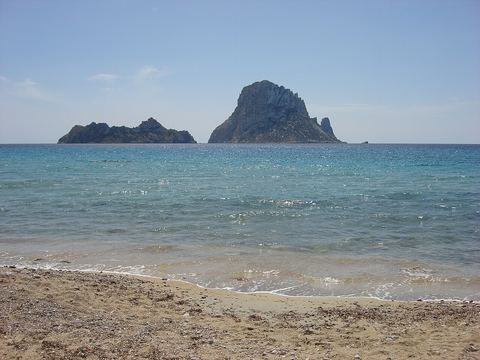
Es Vedrà is the 382-metre limestone islet rising off Cala d'Hort in south-west Ibiza. It's a nature reserve and landing is forbidden. You can admire it from Cala d'Hort, Torre des Savinar or Cap Llentrisca, or from the sea by boat. Autumn and winter sunsets are the best.
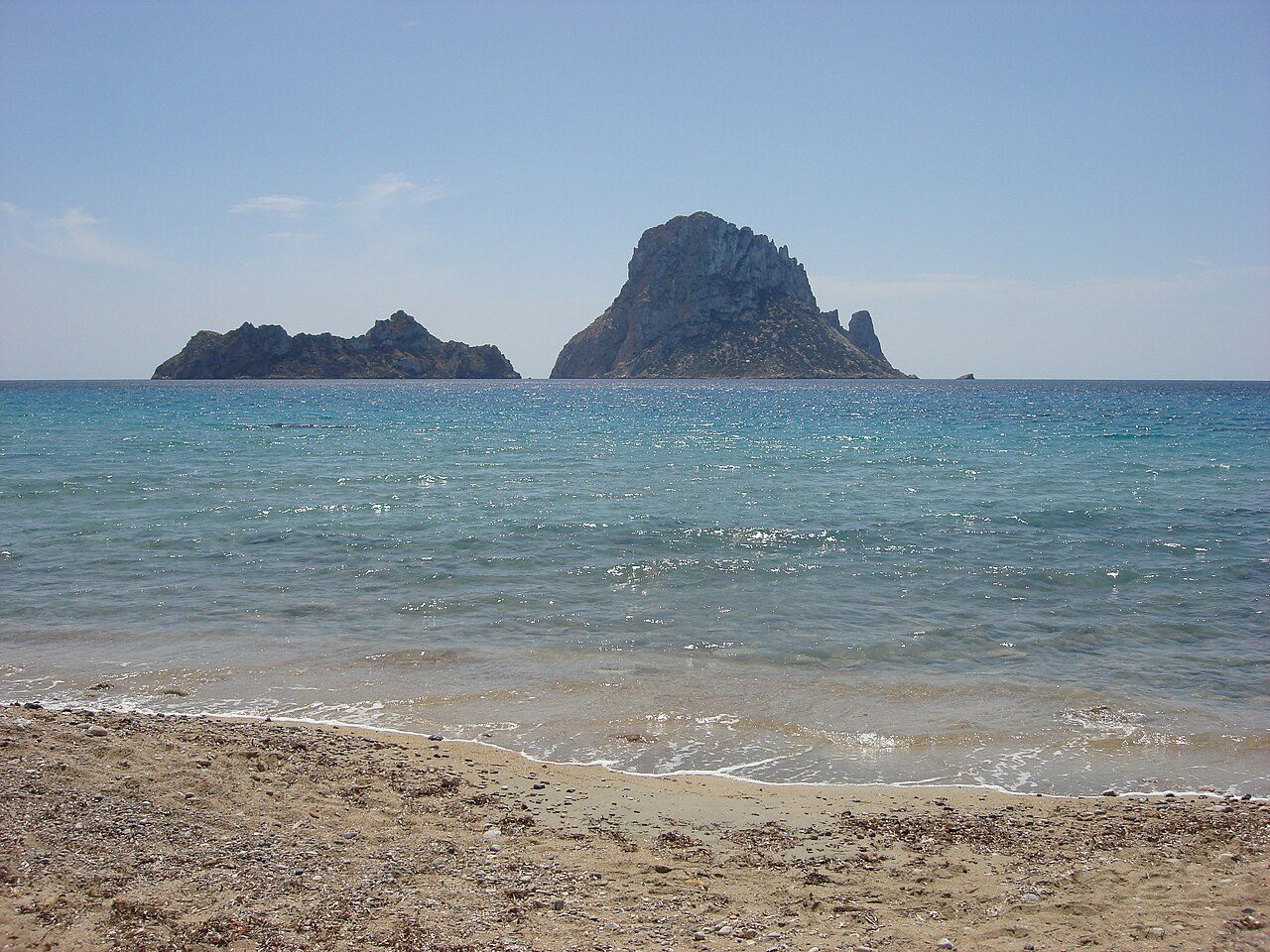
Photo: anibal amaro, CC BY 3.0, Wikimedia Commons
Few silhouettes in the Mediterranean are so recognisable. Es Vedrà appears suddenly as you drive down the road to Cala d'Hort: a pyramid of rock rising almost vertically out of the sea, with its little brother, es Vedranell, lying alongside. For Ibizans it's a lifelong landscape and a place of stories; for visitors, it's the photo that makes the trip to the south-west worthwhile.
You can't set foot on it, but you can enjoy it in plenty of ways. Here's what it is, why it's protected, where to see it from, how much truth there is in its legends and how to get there without wasting the evening hunting for a parking space.
What Es Vedrà is and why it's protected
Es Vedrà is an uninhabited islet less than two kilometres offshore (about 1,900 metres) facing Cala d'Hort, in the municipality of Sant Josep de sa Talaia. According to the Enciclopèdia d'Eivissa i Formentera, its highest point is 382 metres (some guides give higher figures, up to 413), it covers about 62 hectares and its cliffs exceed 350 metres on the steepest face. It's made mainly of heavily folded Cretaceous limestone, which explains its pointed shape.
Beside it is es Vedranell, 128 metres high. Together with the western islets they have formed a nature reserve since 2002: the same Balearic Government decree (24/2002) created the Cala d'Hort, Cap Llentrisca and sa Talaia Natural Park on the facing coast. The reserve is also part of the Natura 2000 network and recognised as an Important Bird Area.
Why it's protected:
- Unique plants: of the roughly 168 plant species on the islet, 13 are endemic, some found only on Es Vedrà or in the Pitiusas.
- Its own wildlife: a subspecies of Ibiza wall lizard (Podarcis pityusensis vedrae) that lives only here, and an endemic snail.
- Seabirds: colonies of Eleonora's falcon, Balearic shearwater (one of Europe's most threatened seabirds), European shag and Audouin's gull. Ospreys show up too.
- The seabed: posidonia meadows, gorgonians and groupers, with bottlenose dolphins in the surrounding waters.
For centuries feral goats lived on the islet, eating the endemic vegetation. In February 2016 the regional government had most of them shot to protect the plants, a decision that caused huge controversy on the island, with legal complaints and thousands of signatures against it. Some survived, and since then there has been debate about how to remove the rest alive.
Can you climb Es Vedrà? No. Landing is forbidden without express authorisation, granted only for scientific or management work. There's no path either, and the rock faces are dangerous even for climbers. Anyone who tries risks a fine and a rescue.
The best Es Vedrà viewpoints
| Viewpoint | How to get there | Best for | Bear in mind |
|---|---|---|---|
| Cala d'Hort (beach) | Car or A15 bus | The islet head-on from the sand | Small car park in summer |
| Viewpoint on the Cala d'Hort road | Car | The first view, with the cove below | Don't stop on a bend or the verge |
| Torre des Savinar | On foot, about 20-30 min up | The highest view, with Vedrà and Vedranell | Track closed to cars, uphill with loose stones |
| Cap Llentrisca | On foot from es Cubells | A wild side view, no crowds | Long route with vertigo-inducing sections |
| From the sea | Boat, kayak or paddleboard | The cliffs up close | No landing, no anchoring on posidonia |
| Sa Talaia | On foot from Sant Josep | The western islets from 475 m | Far away; better with binoculars |
Cala d'Hort
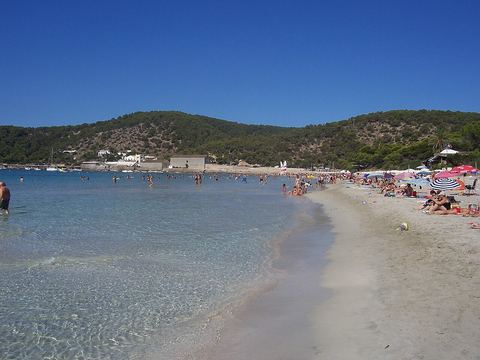
Cala d'Hort beach is the easiest spot: park, walk down to the sand and there it is in front of you. It has seafood restaurants with terraces and in winter it stays wonderfully quiet. It's also where most people watch the sunset opposite the islet. Full details in Cala d'Hort.
Torre des Savinar (the Pirate Tower)
An 18th-century watchtower (completed in 1763) on the clifftop, which everyone calls the Pirate Tower (Torre del Pirata). The nickname comes from Vicente Blasco Ibáñez's novel “Los muertos mandan” (1909), which used that name for it; postcards and guidebooks made it stick. Today you reach it on foot: in 2020 Sant Josep town hall closed the track to traffic with barriers that only residents can open. You can't go inside the tower, and the cliff edge has no railing.
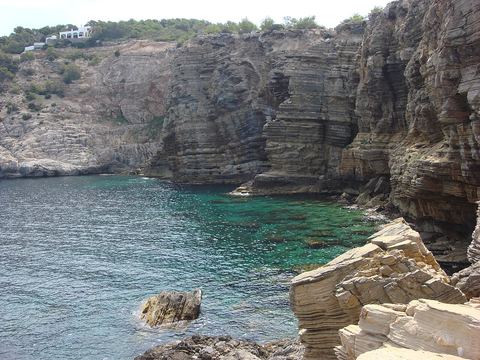
Next to the tower is sa Pedrera, an old sandstone quarry by the sea that many people know as "Atlantis". Getting down means scrambling over rock with no marked path, and firefighters have more than once had to evacuate injured hikers from there on stretchers or by sea: if you're not experienced, stay at the top.
Cap Llentrisca and es Cubells
The route from es Cubells to Cala Llentrisca and its cape offers a side view of Es Vedrà that hardly anyone gets. It's about 9 km there and back according to the town hall, with clifftop sections and little shade. In the square at es Cubells there's a monument to Father Palau, more on whom below, and the A13 bus from Sant Josep reaches the village, with few departures. It's in our Ibiza hiking trails.
Es Vedrà myths and legends
An islet like this was never going to be short of stories. These are the most popular, told as what they are: legends.
- The sirens of the Odyssey. It's said Es Vedrà was the island of the sirens who tried to lure Odysseus with their song. There's no evidence at all, but the image has stuck.
- Tanit's island. Another tradition links it to Tanit, the Punic goddess of fertility, a strong presence in ancient Ibiza.
- The giant of Es Vedrà. An Ibizan rondalla, or folk tale, tells of a giant who lived on the islet and two brothers who climbed up to gather rock samphire. There's another about a white lady who appears on the rock.
- Father Palau. This one isn't a legend: the Carmelite Francesc Palau i Quer spent periods as a hermit in a cave on the islet in the 19th century and wrote about the visions he had there. He was beatified in 1988. In es Cubells he opened an oratory in 1864 that became the origin of the village church.
- The magnetism. The most repeated myth: that Es Vedrà is one of the most magnetic places on earth, that compasses go haywire or that birds lose their way. No study supports it, and the rock is limestone with no concentrations of magnetic metal. What it definitely is, is a place that makes an impression.
- UFOs. For decades there have been stories of lights over the islet. They're part of modern folklore, nothing more.
How to get to Es Vedrà by car, bus and on foot
By car. From Sant Josep de sa Talaia, take the road towards es Cubells and Cala d'Hort; it's about 15-20 minutes on narrow, winding roads. From Ibiza Town or San Antonio, allow about 30-40 minutes. In summer the Cala d'Hort car park fills up at midday and at sunset: arrive early and don't leave the car on the verges, where you'll be fined. To share a car, see the app's car sharing.
By bus. On the 2026 network, the A15 links Sant Josep with Cala Vedella, and some of its departures go via es Cubells and Cala d'Hort. There are few and not all of them make the detour, so check the season's timetable on the ALSA Ibiza website. Many more routes reach Sant Josep. Watch out for the return after sunset: there may be no bus. More in Ibiza bus routes.
By taxi. The comfortable option for going to dinner and getting back at night. Book the return in advance, because there are few free taxis in the south-west.
On foot. From the Cala d'Hort area you walk up to Torre des Savinar on the track that's closed to traffic. Closed shoes, water and a torch if you're watching the sunset and coming down in the dark.
Es Vedrà boat trips: what's allowed
Seeing it from the sea is a different experience: from below, the walls look even more vertical and you grasp the islet's true size. Boat trips leave from San Antonio, Ibiza harbour and coves in the south-west, from group cruises to private boat hire with a skipper. Types, rough prices and what each includes are compared in Ibiza boat trips, and in the app you can search for boat trips.
What to know if you're going on your own:
- No landing on Es Vedrà or es Vedranell.
- No anchoring on posidonia: it's protected in the Balearics. Look for a sandy bottom or use mooring buoys where there are any.
- Respect the birds: in spring and summer they breed on the cliffs. No horns and don't go close to the rock faces.
- Fishing is regulated in the reserve. If you plan to fish, check the rules on Balears Natura first.
- The sea changes fast: the channel between the islet and the coast catches westerly winds and currents. By kayak or paddleboard, only with a good forecast and preferably with a guide.
The best time of day and year to see Es Vedrà
- Autumn and winter sunsets: the sun sets in the south-west and drops very close to the islet. This is the classic image. Exact times and other spots in Ibiza sunset spots.
- Summer sunsets: the sun sets further north, so from Cala d'Hort it goes down to the right of the islet. Still beautiful, but much busier.
- Morning: soft light and almost nobody around. From Torre des Savinar, the morning light falls on the face of the islet you're looking at.
- Hazy days or after rain: with clean air the islet is sharp even from Sa Talaia; in haze it becomes a blue silhouette.
Common mistakes: turning up for an August sunset with no parking plan, coming down from Torre des Savinar in the dark without a torch, leaning over the edge for a photo, and signing up for "trips to climb the islet", which legally don't exist.
Sources and official information
- Fundació de Promoció Turística d'Eivissa · Es Vedrà, es Vedranell and western islets nature reserve
- Govern de les Illes Balears · Balears Natura (protected natural areas)
- Ajuntament de Sant Josep · Closure to traffic of the Torre des Savinar and sa Pedrera track
- Sant Josep tourism · Es Cubells to Cala Llentrisca route
- Enciclopèdia d'Eivissa i Formentera · Es Vedrà
- Enciclopèdia d'Eivissa i Formentera · Torre des Savinar
- Transport Públic d'Eivissa (Alsa) · A15 route
Frequently asked questions
Can you climb Es Vedrà?
No. Es Vedrà is a nature reserve and landing is forbidden without express permission, which is only granted for scientific or conservation work. It also has no path and its rock faces are dangerous. You can see it from the coast, at Cala d'Hort or Torre des Savinar, or sail around it by boat.
What is the best Es Vedrà viewpoint?
Torre des Savinar, on the clifftop, has the most spectacular view, with Es Vedrà and es Vedranell in front of you; it's a 20-30 minute walk up. Cala d'Hort beach is the easiest option. For something different and crowd-free, try the Cap Llentrisca route from es Cubells.
Is it true that Es Vedrà is magnetic?
There's no evidence. It's one of the most repeated myths about Ibiza, but no study has shown any special magnetism, and the islet is made mainly of limestone with no concentrations of magnetic metal. What it does have is a striking shape, a rich history and plenty of legends.
Are there boat trips to Es Vedrà?
Yes. Trips leave from San Antonio, Ibiza harbour and coves in the south-west, and you can also hire a boat with a skipper. They circle the islet and sometimes stop for a swim nearby, but none can land. If you go on your own, don't anchor on posidonia and keep away from nesting birds.
How do you get to Es Vedrà without a car?
By bus, the A15 links Sant Josep with Cala Vedella and some departures go via Cala d'Hort; there are few, so check the seasonal timetable with ALSA Ibiza. Other options are a taxi or a boat trip. To get back after sunset, book a taxi in advance.
How high is Es Vedrà?
According to the Enciclopèdia d'Eivissa i Formentera, 382 metres at its highest point, although some guides give figures of up to 413. It covers about 62 hectares and lies less than two kilometres offshore, opposite Cala d'Hort. Es Vedranell, the islet next to it, is 128 metres high.